
Check St. George Voter Registration
Utah provides a self-service path called Find My Voter Registration Information. It is meant for a voter checking their own record. It is not a browse-by-name list of everyone registered in St. George. The wider launcher also offers separate routes to register, update voter information, change a ballot mailing address, and reach ballot-status alerts.
The app renders its identity form in the browser. The research capture did not expose trustworthy field labels, required-field rules, or the result screen. Those details should be read from the live form when it opens. They should not be inferred from voter tools in other states or from older Utah screenshots.
| Lookup element | Verified type | Required | What is known |
|---|---|---|---|
| Identity inputs | Client-rendered form | Not verified | Use only the labels shown by the live official app |
| Lookup purpose | Self-service search | Applies to the voter | Checks the voter’s own registration information |
| Other actions | Separate official modes | Varies | Register, update information, or change ballot mailing address |
Start at the self-lookup when the goal is a personal status check. A county list or the statewide file is a different product with a formal request route, more fields, and different privacy concerns.
The official Utah voter site shows the self-lookup entry point and its related voter services.
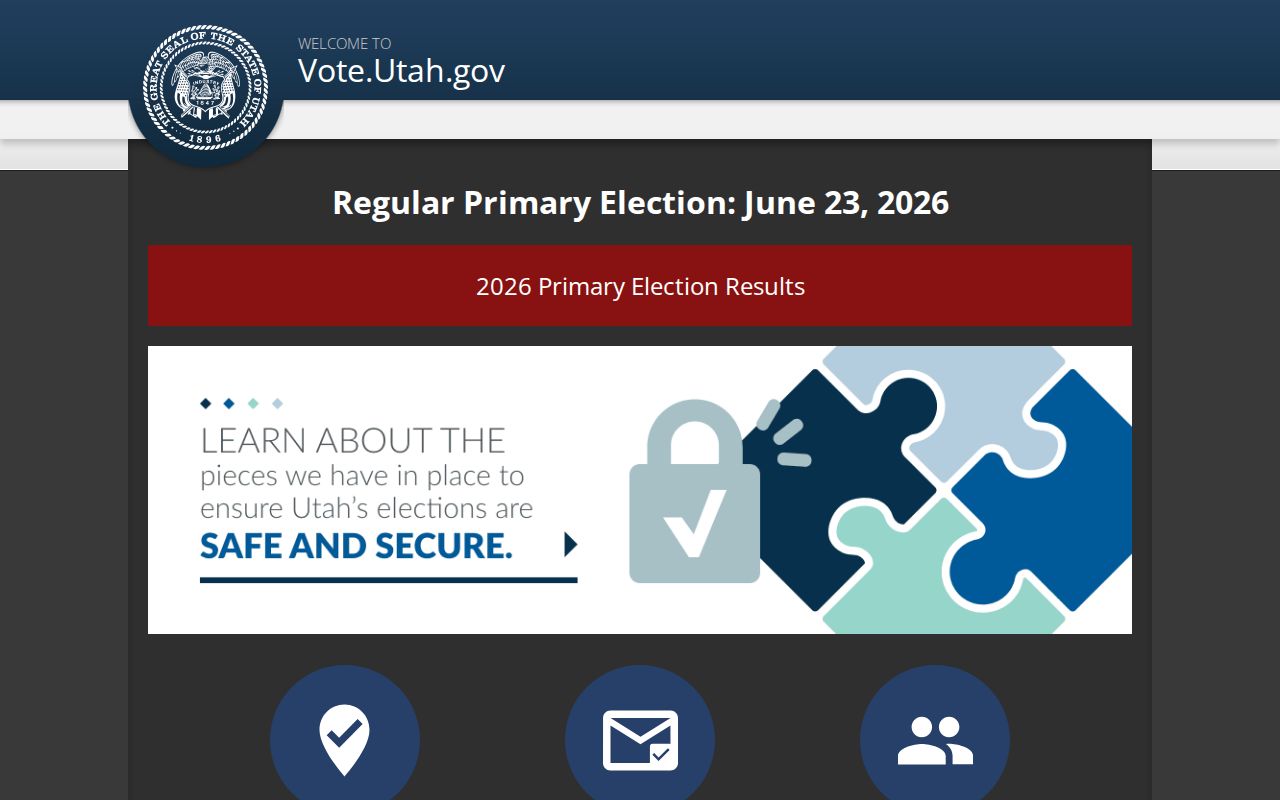
This screen helps distinguish a personal registration check from a request for a county or statewide voter database.
St. George Voter Record Contents
The Utah voter-data page lists the fields in the statewide public file. The file combines identity, address, district, registration-status, and participation data. It is broader than the personal lookup and is delivered as data rather than as a series of profile pages.
| Identity | Full legal name, voter ID, and age range |
|---|---|
| Address | Complete residence including unit, county, mailing address, and mailing city |
| Voting area | Precinct plus congressional, state legislative, school board, county council, and city council districts |
| Registration | Affiliation or unaffiliated status, active or inactive status, and last update |
| Participation | Elections in which the person participated, never the person’s selections |
A district field tells which political boundary includes a St. George address. It does not say how the voter acted. Likewise, an inactive label is an administrative status, not proof that a person left St. George. Check the update date and use the official personal lookup when the record belongs to you.
Note: The statewide file records participation, but the secret ballot keeps every candidate and issue choice outside the voter record.
Private St. George Voter Fields
Utah draws a clear line between public St. George voter fields and sensitive identifiers. Public information can include the name, physical and mailing addresses, age range, affiliation, and participation history. The state’s voter privacy explanation should be checked before using or requesting a voter file because protected data is not made public merely because the registration itself is an official record.
Confidential under Utah law. Date of birth, driver license or state ID number, Social Security number, email, and phone are protected for all voters under Utah Code §63G-2-302 and §§20A-2-601 through 607.
Protected fields should never be filled in from another source and presented as part of an official voter record. At-risk status can also withhold otherwise public voter information for a person who qualifies. General access under Utah’s Government Records Access and Management Act does not cancel those election-law protections. The broader access-law framework belongs with St. George public records.
St. George At-Risk Voter Protection
Utah’s at-risk designation can protect a St. George voter who faces more than ordinary privacy concern. Qualifying categories include a victim of domestic or dating violence and a household member, a threatened person, a law officer, an armed-forces member, a public figure, or a person covered by a protection order. The process is designed to keep eligible information from disclosure, not to erase the voter’s registration.
The at-risk designation form asks for a full name and contact details. Address or date of birth may be used to locate the registration. The applicant identifies a qualifying category, provides verification attachments, and signs a perjury declaration. A narrative is not required for the specified violence categories. The signed request can go through the county clerk or the Lieutenant Governor’s elections office.
Do not publish or pass along a protected address. Public availability of other voter-roll fields never authorizes stalking, threats, impersonation, identity theft, or exposing information that the law withholds.
St. George Voter Records Desk
Washington County Elections is the local channel for St. George registration and county or district subsets. Its office is at 111 East Tabernacle, St. George, UT 84770-3443. The posted phone is 435-301-7248, fax is 435-301-7249, and email is elections@washco.utah.gov. Posted office hours are 8 a.m. to 5 p.m.
Washington County Elections
111 East Tabernacle
St. George, UT 84770-3443
435-301-7248
elections@washco.utah.gov
The county has published a voter-information public-service request form, but the captured PDF was blocked and an older manifest URL failed. Its exact fee, geography choices, media choices, and certification text cannot be confirmed from the available research. Ask Elections for the current form and terms. Do not apply the statewide price to a Washington County subset.
The Washington County Elections page is the official local starting point for voter resources and contact information.
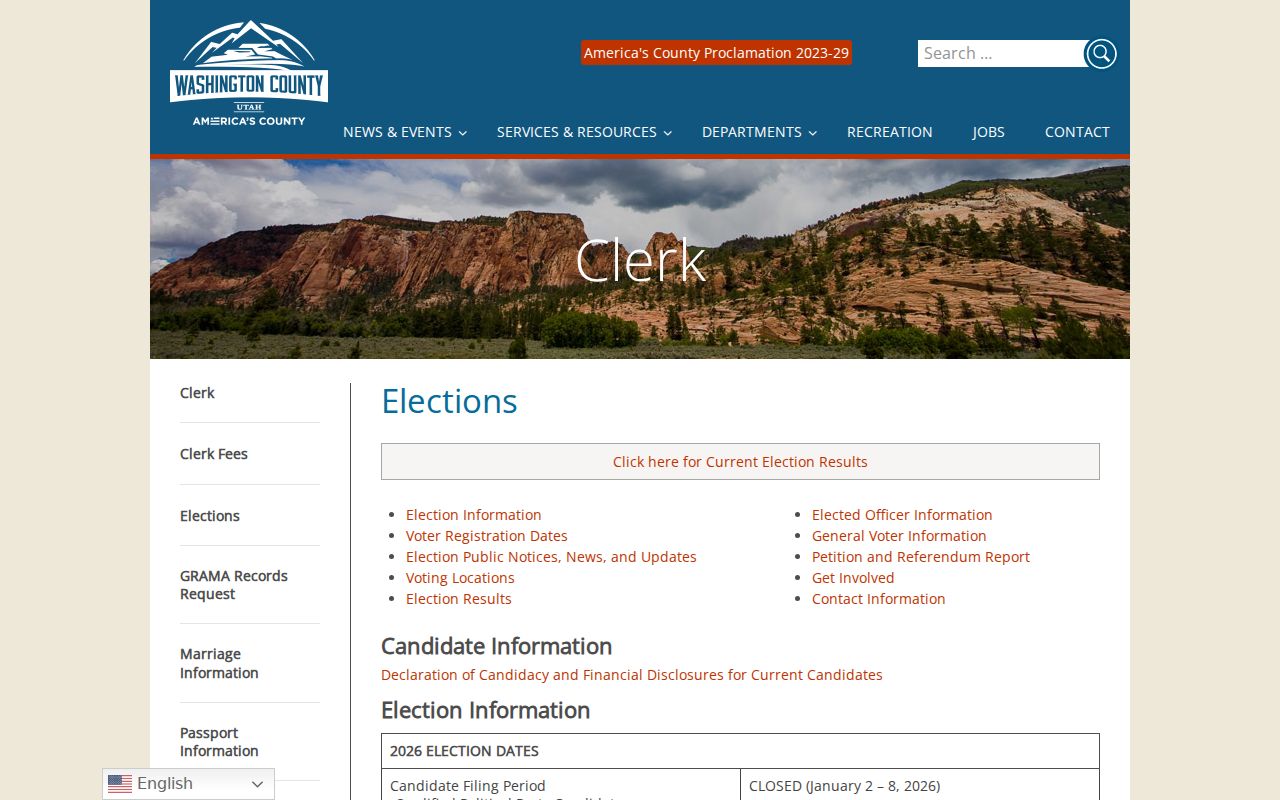
The county screen confirms the local route even when the downloadable request form needs direct verification.
St. George Statewide Voter File
The statewide voter database costs $1,050 as a one-time purchase. Utah describes it as a tab-delimited file of about 150 MB, sent by emailed download within one business day. The purchase does not include a subscription, free updates, or a refund. St. George voters appear within the statewide data alongside county, precinct, and district fields.
- Choose the right scope. Use Washington County Elections for a county or district subset, or the Utah data request for the full statewide file.
- Review the official request page and provide only the information its current workflow asks for. Do not rely on an old copy of a form.
- For the statewide database, confirm the posted $1,050 price and tab-delimited delivery terms before submitting the order.
- Store and use the file with care. Remove protected information from any notes and verify records that may have changed since the file was produced.
Utah also sells “Who Has Voted” and “Who Has Been Sent an Absentee Ballot” reports for $35 per election. Those reports are available only during regular even-year primary and general elections. Daily delivery runs from 21 days before the election through the eve of the election. Recent precinct results are free.
St. George Vote History Explained
Participation history is often misunderstood. A public voter file may show that a person took part in a named election. It never reports the candidates, ballot questions, or positions selected. This limit is central to reading St. George voter records with care.
Participation is not a ballot choice. A record of voting confirms only that the voter participated in an election, while every selection remains secret.
The distinction matters in St. George family and civic research. Participation can show that an election appears in the voter’s history, but it does not establish beliefs, support, or intent. Avoid drawing claims that the file cannot prove.
St. George Registration List Maintenance
St. George voter rolls change through scheduled list maintenance. Under Utah Code §20A-2-502, election officials receive weekly driver-license name and address information and registrar death updates. Corrections, Department of Corrections information, and data from other states arrive at least monthly. Officials also review duplicates and conflicting records.
Analysis must occur at least 90 days before regular primary and general elections. A record can move through confirmation and inactive status before eventual removal after the federal election cycles. Utah’s NVRA data page publishes monthly confirmation and removal reports. Those reports explain system activity, while the personal lookup is still the better place to check one voter’s current status.
Registration records are retained as permanent records in Utah Archives Series 28818. Permanent retention does not mean each past local poll book is online or indexed by name.
St. George 2026 Voter Snapshot
A temporary rule under §20A-2-607 froze current voter data until May 25, 2026. Before that date, the available product relied on a March 8 snapshot. The freeze has passed, but it explains why a file obtained early in 2026 may carry an older reference date.
File dates matter in a fast-growing city. Treat a purchased roll as a snapshot, not live proof of a present address or status. Compare the file date with the last-update field. A St. George voter checking their own current information should use the official self-lookup rather than assume an older bulk row is still current.
Note: Record the download date beside any voter-file analysis so an old snapshot is not mistaken for current registration data.
St. George Historical Voter Records
Utah treats St. George voter registrations as permanent records, which gives historical research a path beyond today’s live tools. Yet the available research does not identify exact years for Washington County poll books or local registration registers. No date range should be invented from the statewide retention rule.
Ask Washington County Elections whether the record remains with the clerk, then check Utah State Archives Series 28818 for transferred registration material. Give a full name, a likely St. George address, and a narrow time span if known. The office or archives can then confirm the series, access status, and available format.
Lawful research does not permit harm. Utah’s stalking law, §76-5-106.5, and identifying-information disclosure law apply even when a source began as a public record. Never use voter data to harass, threaten, impersonate, or reveal a protected location.